Retiring on Social Security: How Far It Goes by State
Social Security replaces only about 40% of a middle earner's income — and the savings gap it leaves swings enormously by state, from cost-of-living 17% below average in Oklahoma to 86% above in Hawaii. Here's a map, the gap math, and how to size your own number.
Social Security alone won't fund a comfortable retirement in any state — it's designed to replace only about 40% of a middle earner's pre-retirement income, and the gap you have to cover from savings swings enormously depending on where you live. The average retired worker collects about $2,071 a month in 2026 (roughly $24,850 a year), per the Social Security Administration. Whether that stretches far or barely dents your budget comes down to local cost of living — which ranges from about 17% below the national average in the cheapest states to nearly double it in Hawaii. Here's how far your check goes, and how to size the gap for your own state.
Cost of living, state by state
The map below shades each state by its cost-of-living index (U.S. average = 100) from the Missouri Economic Research and Information Center's second-quarter 2026 data — the standard dataset behind most "retire by state" rankings. Darker = pricier.
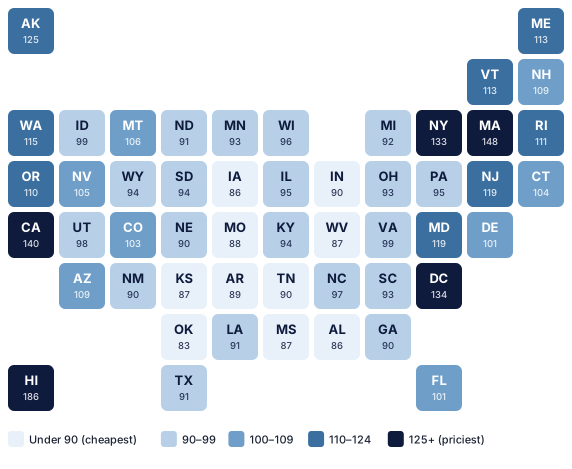
Source: MERIC Cost of Living Index, Q2 2026 (U.S. average = 100). A reading of 90 means costs run about 10% below the national average; 120 means about 20% above.
The spread is stark. In the least expensive states, your Social Security check covers noticeably more of the basics:
| Cheapest states | Index | Priciest states | Index | |
|---|---|---|---|---|
| Oklahoma | 83 | Hawaii | 186 | |
| Alabama | 86 | Massachusetts | 148 | |
| West Virginia | 87 | California | 140 | |
| Kansas | 87 | New York | 133 | |
| Mississippi | 87 | New Jersey | 119 |
How to size your own gap
The honest math is simple, and you can run it for any state. Start with what a comfortable year costs where you live, subtract your annual Social Security, and the remainder is what your savings must cover:
- Estimate your comfortable annual budget. Analyses like GOBankingRates' put a comfortable one-person retirement near $60,000 a year nationally, but that's an estimate that scales with your state's cost index — well under that in Oklahoma or Mississippi, far above it in Hawaii or California.
- Subtract your Social Security. The 2026 average is about $24,850 a year; check your own figure in your my Social Security account or estimate it with our benefits calculator.
- Turn the gap into a nest egg. Under the common 4% rule, multiply the annual gap by 25. A $35,000 gap implies roughly an $875,000 nest egg; a $20,000 gap, about $500,000.
A useful rule of thumb from the same analysis: under the 4% rule, each extra $100 a month of Social Security trims the savings you need by about $30,000 — which is a big reason when you claim matters so much, since delaying permanently raises that monthly check.
Two cautions
- Cost of living isn't the whole picture. A cheap state can still tax part of your benefits — see our state-by-state guide to Social Security taxes — while a pricey state may fully exempt them. Property taxes, health-care access, and closeness to family matter too.
- These averages hide a lot. The "average" benefit assumes a full career of middle earnings; if your record has gaps or low-earning years, your own check — and your gap — will differ. And roughly 4 in 10 older households rely on Social Security for most of their income, which makes the savings gap above the central retirement-planning challenge, not a footnote.
What it means for you
No state lets the average retiree live comfortably on Social Security alone — but the size of the shortfall is very much a geographic choice. Before anchoring to a state, run the three-step gap math with your benefit and your target budget, and weigh taxes and health care alongside the cost index. To put a real number on step 2, estimate your benefit at different claiming ages with our free benefits calculator, and keep this year's key figures handy with our cheat sheet.
This article is general educational information, not financial advice. The average benefit figure is from the Social Security Administration's 2026 COLA fact sheet; the cost-of-living index is from MERIC (Q2 2026); comfortable-retirement cost estimates are GOBankingRates' analysis, not official figures, and your own costs will vary. SocialSecurityNews.com is not affiliated with or endorsed by the Social Security Administration, MERIC, or GOBankingRates.
Frequently asked questions
- Can you retire on Social Security alone?
- In almost no case comfortably. Social Security is designed to replace only about 40% of a middle earner's income, and the average 2026 benefit is about $2,071 a month ($24,850 a year) — below the cost of a comfortable one-person retirement in every state. Most retirees need savings or other income on top of it.
- Which states are cheapest to retire in?
- By overall cost of living (MERIC Q2 2026, U.S. average = 100), the least expensive states are Oklahoma (83), Alabama (86), Iowa (86), West Virginia (87), Kansas (87), and Mississippi (87) — where costs run roughly 13–17% below the national average, so a Social Security check stretches further.
- Which states are most expensive to retire in?
- Hawaii is far and away the priciest (cost index 186, about 86% above the national average), followed by Massachusetts (148), California (140), New York (133), and Washington, D.C. (134). New Jersey, Alaska, Maryland, and Washington state round out the high-cost group.
- How much do I need to retire if I get Social Security?
- Estimate your comfortable annual budget for your state, subtract your yearly Social Security (the 2026 average is about $24,850), and multiply the remaining gap by 25 (the 4% rule). For example, a $35,000 annual gap implies roughly an $875,000 nest egg. Your own number depends on your benefit and where you live.
- Does moving to a cheaper state fix a Social Security shortfall?
- It helps, but weigh the whole picture. A lower cost of living shrinks your savings gap, but some low-cost states still tax benefits while some high-cost states fully exempt them, and health care, property taxes, and family proximity matter too. Compare total costs, not just the cost-of-living index.
Reference: SocialSecurityNews